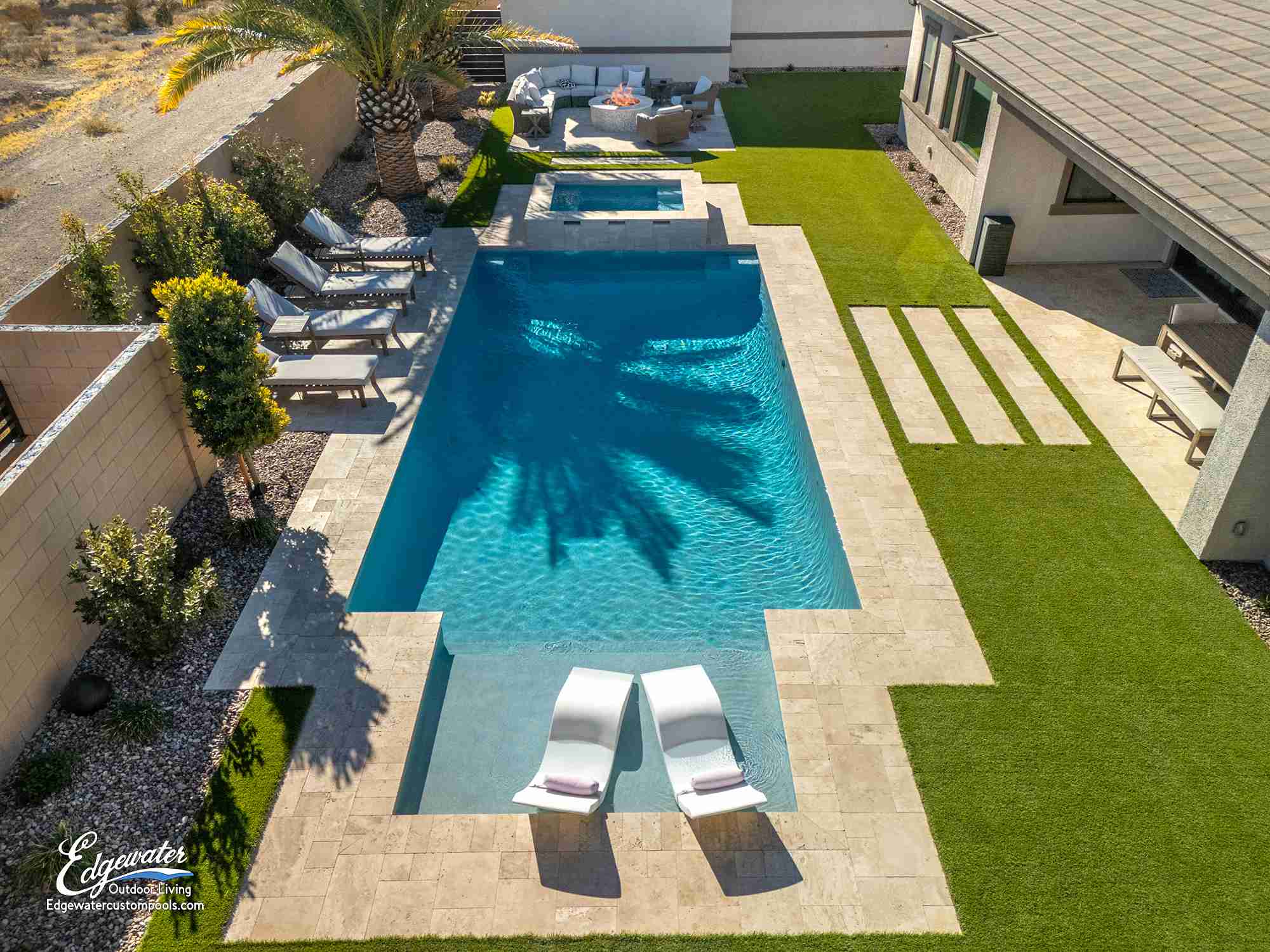
Southern Nevada has one of the longest natural swim seasons in the country. That is one of the main reasons people build pools here. What surprises new pool owners is how quickly the water cools once the nights turn, and how much of that is determined by decisions made during design rather than by equipment bought afterward.
Understanding where the heat actually goes makes every other choice clearer.
Where a desert pool loses its heat
Most people assume cold air cools a pool. Air temperature plays a part, but in a dry climate it is not the main mechanism.
Evaporation is the dominant path
Evaporation carries away the largest share of a pool’s heat, and the Mojave is close to ideal conditions for it: very low humidity, frequent wind, and enormous day-to-night temperature swings. Every gallon that lifts off the surface takes energy with it.
The scale is substantial. An in-ground pool in Southern Nevada loses roughly 48.6 gallons per square foot per year to evaporation, which works out to somewhere near 22,842 gallons annually for a typical uncovered pool. That is water leaving, and heat leaving with it.
Wind accelerates everything
Moving air across the surface speeds evaporation sharply. An exposed pool in a windy corridor loses heat far faster than a sheltered one, even at identical air temperatures. This is why two neighbors with the same pool and the same heater can have noticeably different experiences.
Clear desert skies pull heat upward at night
Cloud cover acts like a blanket. Southern Nevada does not have much of it, so on a clear night a pool radiates heat directly to the open sky. This is the same effect that makes desert nights drop so far below daytime highs, and it works on your water all night long.
The single most effective thing you can do
A pool cover reduces evaporation by about 90 percent. Nothing else comes close, because it addresses the dominant loss path directly rather than trying to outrun it with added heat.
A cover also blocks night sky radiation, keeps windblown debris and dust out of the water, and reduces the chemical demand that comes from constant refilling with hard local water. In practical terms, a covered pool holds usable temperature for weeks longer on either end of the season than the same pool uncovered.
There is a code benefit as well. Where a wall of the house forms part of your pool barrier, a safety cover complying with ASTM F1346 is one of the approved secondary protection options under the Southern Nevada Amendments. One element, two purposes.
Types worth knowing
- Automatic covers deploy at the touch of a switch, which is the only reliable predictor of whether a cover actually gets used. Integrating the track or housing at design stage produces a far cleaner result than retrofitting.
- Safety covers anchor to the deck and carry weight, satisfying barrier requirements as well as reducing evaporation.
- Solar covers are the simplest option and add passive heat gain, though they require handling and storage every time the pool is used.
Heating: gas versus heat pump in this climate
Both work here. They suit different patterns of use, and the desert climate makes the distinction sharper than it would be elsewhere.
Gas heaters
Gas heats water quickly regardless of outside air temperature. That makes it the right tool for occasional, on-demand use: you want the spa warm this evening, or the pool comfortable for a weekend in November. It does not care how cold the air is.
Heat pumps
A heat pump moves heat rather than generating it. It draws outside air across an evaporator coil, extracts warmth from it, and transfers that into the pool water. Because it is moving existing heat, it is considerably more efficient over sustained operation.
The constraint is ambient temperature. Heat pumps operate efficiently when outside air stays above roughly 45 to 50 degrees Fahrenheit. Below that, efficiency falls off.
Mapped onto Southern Nevada, that is a good fit for much of the year. Spring and fall, the exact shoulder seasons where most people want to stretch their swim window, sit comfortably in a heat pump’s efficient range. Deep winter nights are where it struggles, which is precisely when most homeowners are not swimming anyway.
Which suits you
- Sustained, season-extending warmth across spring and fall: a heat pump, paired with a cover, is the efficient combination.
- Occasional rapid heating, or a spa used year-round: gas delivers heat fast whenever you want it.
- Both: many valley homes run a heat pump on the pool and gas on the spa, which plays to each technology’s strength.
Design choices that lengthen your season
These are decided before a shovel goes in the ground, and they are difficult to change afterward.
- Wind sheltering. Positioning the pool relative to prevailing wind, and using walls, structures or planting as a windbreak, reduces the dominant heat loss path permanently and without any equipment.
- Sun exposure. A pool that receives good afternoon sun gains real passive heat. Shade structures are valuable in July and work against you in October, so their placement is a genuine trade-off worth thinking through.
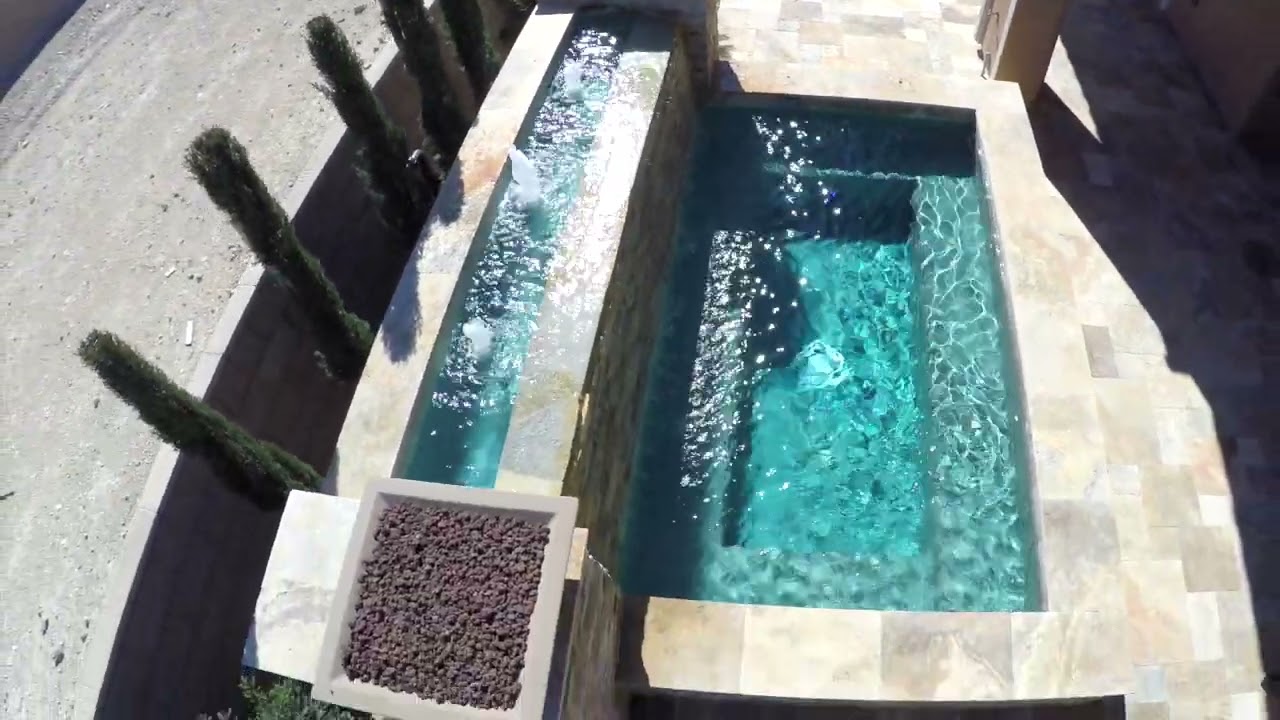
- Water features. Spillways, fountains and waterfalls are beautiful and they are also evaporation machines, because they multiply the surface area in contact with dry air. Running them selectively rather than constantly preserves both heat and water.
- Surface area and depth. A shallower pool warms faster and cools faster. A deeper pool is more thermally stable. Tanning ledges and beach entries heat quickly and pleasantly in shoulder season.
- Dark interior finishes absorb more solar energy than light ones. The effect is modest but real, and it costs nothing to factor into a finish decision you are making anyway.
Frequently asked questions
When does an unheated pool become comfortable in Las Vegas?
Most unheated valley pools become comfortable in late spring and stay that way through early fall, with the exact window depending on sun exposure, wind, depth and whether a cover is used. Covers and sheltering commonly add several usable weeks on each end.
Is it worth heating a pool in the middle of a Las Vegas summer?
Usually the opposite problem. Mid-summer pools can get uncomfortably warm, and some homeowners run equipment at night specifically to shed heat. A cover left on through peak summer days can make this worse rather than better.
Does a solar cover work as a safety barrier?
No. A solar cover is a thermal product and is not rated to carry weight. Only a safety cover complying with ASTM F1346 meets the barrier provisions in the Southern Nevada Amendments.
Can I add a heater to an existing pool?
Usually yes, though it depends on existing equipment pad space, electrical capacity and gas line sizing. Older homes frequently need an electrical review before a heat pump can be added.
Designing for a longer season
The homeowners who get the most out of a Southern Nevada pool are the ones who thought about heat, wind and covers during design, not the ones who bought the biggest heater afterward. Edgewater Custom Pools and Landscaping designs and builds across Las Vegas, Henderson and Mesquite, and we are happy to walk through how your lot’s orientation, exposure and layout will shape your swim season before anything is finalized.