Pool resurfacing and replastering in Las Vegas and Henderson. Pebble, quartz and plaster finishes, and why our hard water decides how long yours lasts.
Most pools give plenty of warning. The signs tend to arrive gradually enough that owners stop noticing them, which is why a fresh pair of eyes is useful.
Not everything on that list means the pool needs resurfacing tomorrow. Some of it is cosmetic, some of it is a water chemistry problem that will eat a new finish just as fast, and some of it is structural. The useful thing is knowing which is which before spending money, and that is what a site visit is for.
Two things worth knowing that are commonly mistaken for defects. Fine hairline crazing is normal in cementitious finishes and is not a defect. So is mottling, the cloudy shading that shows more on overcast days or at night under pool lights. The National Plasterers Council states both plainly, and both are more visible on coloured finishes. We will tell you when something is normal rather than selling you a resurface you do not need.
If you are weighing a resurface against a wider project, our article on when to remodel a pool covers that decision.
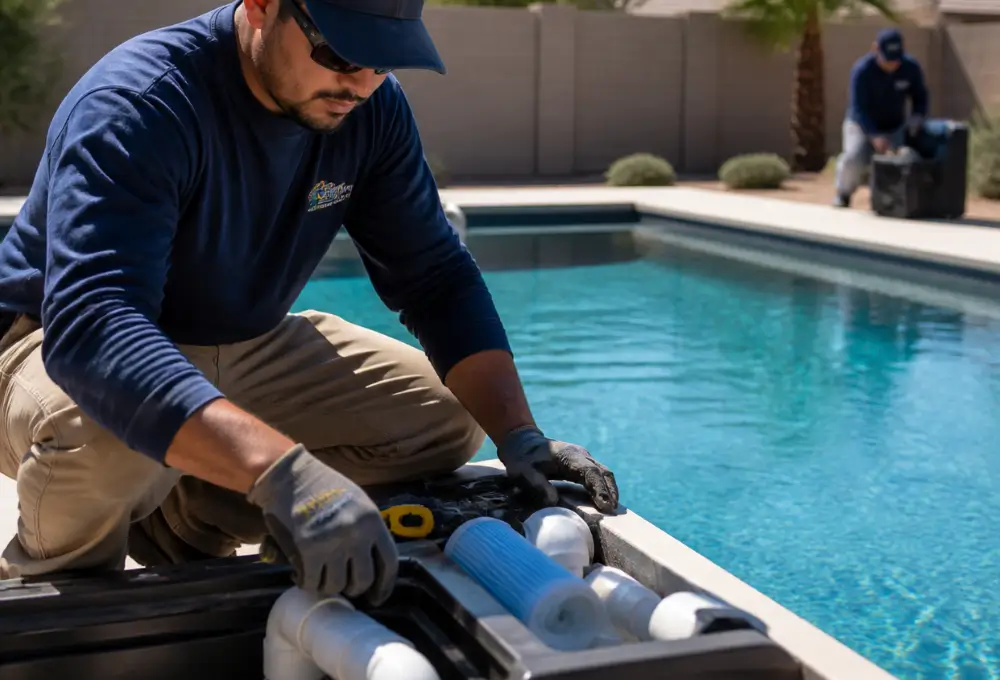
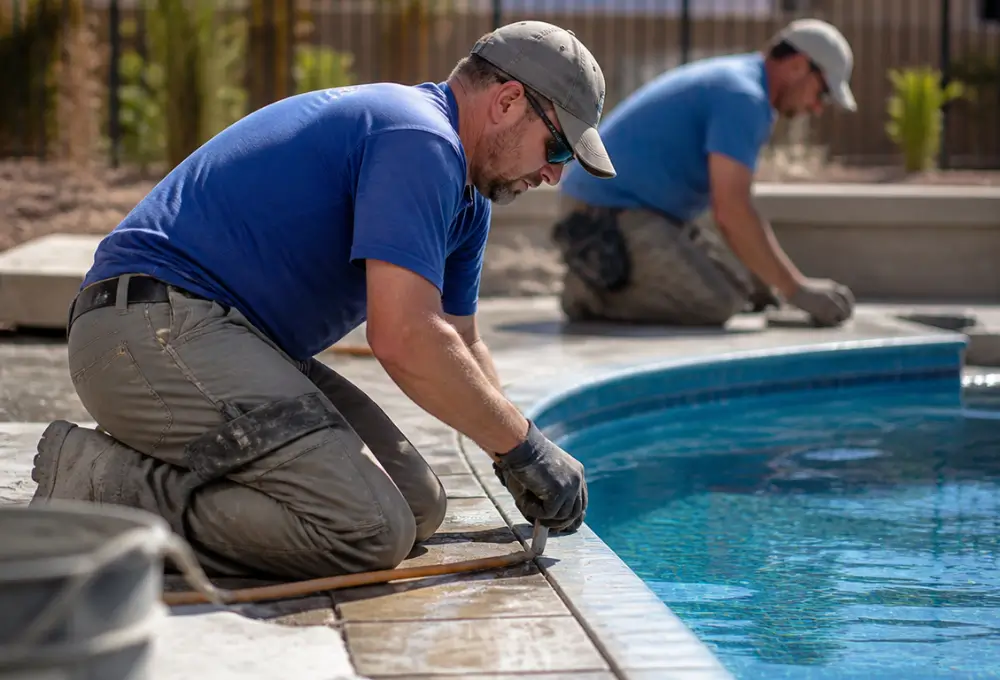
Resurfacing a pool without understanding why the last surface failed is how a household ends up doing it twice. The causes are distinct and they point at different fixes.
Etching comes from aggressive water. When water is undersaturated with calcium, it takes calcium from the nearest available source, which is the cement in your finish. The result is a uniformly rough, chalky surface across the whole pool rather than damage in one area. Etching is a chemistry failure, not a product failure, and a new finish in the same water will go the same way.
Scale is the opposite problem. When water holds more calcium carbonate than it can keep in solution, the excess precipitates onto whatever surface is nearby, starting where the water is warmest and the pH is highest. That is why the waterline tile goes first. In a valley this hard and this evaporative, scale is the more common of the two.
Staining divides into metal and organic. Metal stains come from dissolved iron, copper or other metals coming out of solution onto the surface, and the colour tells you which: brown for iron, blue-green for copper. Organic stains come from leaves and debris leaching tannins, and they tend to be shaped like whatever sat there. Because plaster is porous, stains are harder to remove than from a vinyl or fibreglass pool, and some only come out with the pool drained.
Spalling is shallow flaking of the very top layer, leaving rough pitted craters. It is caused by troweling conditions during the original installation rather than by your water, and it shows up most at step radii, shallow-end floors and around the main drain, where finishing is hardest. Hot, dry, windy days make it more likely, which is a relevant point in this valley.
Delamination is deeper. It is the finish separating from what it was bonded to, either the previous layer or the shell. It is a preparation failure from a previous resurface, and it is the reason surface prep is worth more than the finish you put over it.
Calcium nodules are the crusty raised bumps that appear in previously replastered pools. They form where water finds a flaw in the finish, leaches calcium out from behind it, and deposits it at the surface. The bump is a symptom of something underneath, which is why scrubbing them off does not solve anything.
The practical takeaway: a resurface is the right answer for a worn, etched, stained or spalled surface. It is not the answer for water that is out of balance, because the water will follow the new finish. Both usually need addressing at once.
There are three broad categories, and they differ in composition, texture and how they age.
Plaster is the traditional finish: white Portland cement blended with crushed marble, troweled smooth so the cement paste comes to the surface. It gives the classic look at the lowest point of entry, and it is the most vulnerable of the three to aggressive water, because the marble aggregate is calcium-based and dissolves readily in acidic conditions. Modern fortified plasters perform better than the marcite of forty years ago.
Quartz finishes blend cement with coloured quartz aggregate. Quartz is considerably harder than marble and far less soluble, which is the entire point: the same water that etches a plaster surface has a harder time with quartz. The surface is slightly textured and slip-resistant, and the colour range is wide.
Pebble and exposed aggregate finishes set natural pebbles in fortified cement, then wash the surface to expose the stone. This is the most durable category and the most forgiving in hard water, and the texture ranges from the pronounced feel of large-pebble finishes to the near-smooth feel of polished and small-pebble products. Glass beads are blended into several lines for sparkle.
Edgewater works with Wet Edge, which offers more than 70 colours across six product lines: Altima, Luna Quartz, Primera Stone, Prism Matrix, Serenity Stone and Signature Matrix, spanning plaster, quartz, pebble, polished pebble and glass bead. We also work in the Pebble Technology range, including PebbleTec, PebbleSheen, PebbleFina, PebbleBrilliance, PebbleEssence and PebbleBreeze.
We bring samples to the pool rather than asking you to choose from a screen. Finish colour reads completely differently wet than dry, differently in sun than in shade, and differently with your decking and coping next to it.
This is the question everyone asks and the one with the least reliable answer available publicly, so here is what is actually published and by whom.
SGM gives traditional plaster 7 to 10 years, quartz 15 to 20 years, and pebble or exposed aggregate 20 years or more. Pebble Technology International gives plaster 5 to 10 years, quartz around 7 to 15 years, and pebble over 20 years with proper maintenance and pool chemistry.
Those are manufacturer figures, the two manufacturers disagree with each other, and each range happens to flatter that company’s own premium product. Treat them as orientation rather than as a specification. The National Plasterers Council declines to publish a lifespan at all and says only that surface longevity depends on maintaining water chemistry after start-up.
That last point is the honest answer. In this valley, water chemistry decides more about how long your finish lasts than the category you choose. A pebble finish in neglected water will not reach twenty years, and a well-maintained quartz finish will outlast a pebble finish that nobody tested. Our article on how long pools last in Las Vegas goes into this further.
This is the part that separates a resurface done here from one done anywhere else, and it is the reason a national chain’s standard procedure is not quite right for this valley.
The Las Vegas Valley Water District publishes the valley’s total hardness at 280 ppm, which is 16 grains per gallon, with total dissolved solids averaging 591 ppm, calcium at 75 ppm, alkalinity at 137 ppm and an average pH of 7.8. That is hard water by any national standard, it comes from Colorado River minerals, and it is what fills your pool and tops it off every week.
Two consequences follow, and they pull in opposite directions.
First, our evaporation rate is high and relentless. Evaporation removes water and leaves every dissolved mineral behind, so a pool here concentrates its own calcium through the summer, and then gets topped off with more hard water. That is the mechanism behind the scale line on your tile. Warm water pushes it further, because warmer water holds less calcium carbonate in solution.
Second, the correction most people reach for makes the opposite problem worse. Chasing scale by driving pH down too far takes the water past balanced and into aggressive, where it starts dissolving calcium out of the finish instead of depositing it. Etching a brand new surface in the first season is a real and avoidable outcome.
The tool that keeps both in view is the saturation index, usually called LSI. It is a single number combining pH, temperature, calcium hardness, carbonate alkalinity, stabiliser and total dissolved solids, and it tells you whether water is balanced, aggressive or scale-forming. Zero is balanced. Published target bands vary by source, and the finish manufacturers we work with specify negative 0.3 to positive 0.3, held as close to zero as practical.
A note that catches people out: finish manufacturers direct that a new pool is not filled with softened water. Running a fill through a water softener is not a workaround for our hardness, and doing it can cause real problems during curing. The answer is managing balance, not removing calcium at the hose.
Our article on desert water quality and pool longevity covers the wider effects of Las Vegas water on pool equipment and surfaces.
The sequence varies with condition and scope, but the shape of the job is consistent.
This is also the only moment in a pool’s life when the shell is empty and visible, which makes it the sensible time to deal with anything else that has been on the list: equipment, lighting, a salt system, automation. Those are straightforward now and disruptive later. Where a resurface is part of a larger project, see pool renovation.
On how long the pool is out of service, we will give you a schedule for your specific job rather than a number off a web page. What we can tell you is the fixed milestones the finish manufacturers set, because those do not move: the fill runs continuously once started and typically takes between 18 and 36 hours, equipment runs continuously for at least five days or until the cement dust is gone, the heater stays off for at least 14 days, and the finish is not fully cured or colour-final until day 28.
This is the section we would keep if we had to delete the rest of the page. More new finishes are damaged in their first month than in the ten years that follow, and almost all of it is avoidable.
A new finish cures chemically rather than simply drying, and during that period it is soft, porous and chemically active. What the water does to it in those four weeks is permanent.
The requirements the finish manufacturers publish:
Daily acid addition in the first fortnight is normal rather than a sign something is wrong. The surface is releasing material into the water as it cures, and the water needs correcting as it does.
Edgewater manages the start-up rather than handing you a leaflet and leaving. Where a household would rather not be responsible for the brushing and testing schedule, our pool maintenance team can carry the full 28 days.
If your pool is on salt, or you are converting to salt as part of the project, the sequence matters and gets handled wrong often enough to be worth its own section.
No salt goes in for at least 28 days after a new finish. That is not a precaution, it is a warranty condition, and salt sitting on an uncured surface can scale, stain or discolour it permanently.
After the start-up period, a salt pool runs to different chemistry targets than a chlorine pool on the same finish, with calcium hardness held in a tighter band and total dissolved solids expected to sit much higher because the salt itself is dissolved solids. Those published targets are written for high-performance finishes and are specifically not recommended for traditional plaster, which is a real consideration if you are choosing both a finish and a sanitation system at the same time.
We cover salt systems, what hard water does to a cell, and what salt does to stone coping on our saltwater pool systems page.
A resurface starts with an empty pool, and where that water goes is regulated here.
The Las Vegas Valley Water District requires pool water to be drained directly to the sanitary sewer system through the sewer clean-out port, at or below 12 gallons per minute, so the water can be recycled and reused. Draining into the street, gutters or storm drains is a violation of local codes.
Clark County cites the code directly: releasing pool water or backwash filter waste into a storm drainage system violates Clark County Code Chapter 24.40, because storm drain water flows untreated into Lake Mead. The City of North Las Vegas makes it unlawful to drain a pool into the street or storm drain where a public sewer is available. On a property with a septic system, the Southern Nevada Health District prohibits discharging pool water or filter backwash into or over the septic system.
There is a second reason draining is not a do-it-yourself job, and it has nothing to do with the water rules. An empty pool shell in saturated or expansive ground can move, and a pool that floats or cracks while empty turns a resurface into a structural repair. Drainage timing, groundwater and hydrostatic relief are part of why this is professional work.
For more on local water rules, see our article on Nevada pool size limits and water rules.
We will be straightforward about this, because the published guidance is not.
Clark County’s Building Administrative Code requires a permit before constructing, enlarging, altering, repairing, moving or demolishing a pool or spa, and its list of work exempt from a building permit does not include interior finish work. The City of Las Vegas and the City of Henderson do not publish an explicit determination on finish-only resurfacing either way.
So rather than tell you on a web page that a permit is or is not required for your project, we confirm it with the authority having jurisdiction for your address before work starts. If the scope grows to include plumbing, electrical, gas or structural work, which it often does once the shell is visible, permits are required and we handle them.
Your jurisdiction is set by your address, not your mailing city. A home with a Las Vegas address can sit in unincorporated Clark County, which is a different building department. Our guide to pool permit requirements across Clark County, Henderson and North Las Vegas explains how to work out which one you are in.
An empty pool is an opportunity, and the things that are straightforward now become a much bigger job once the water is back.
Waterline tile and coping are the obvious ones, and replacing them during a resurface rather than afterward avoids doing the same work twice. Equipment changes are far simpler with the pool down, which is the natural moment for pool heater installation, a variable-speed pump, or pool automation. Lighting niches are accessible. Plumbing repairs are visible rather than guessed at.
Decking is the other one worth raising. A new interior finish against tired decking tends to highlight the decking rather than hide it, and our pool decking options can be scheduled alongside the resurface.
We will tell you which of these genuinely make sense to combine and which can wait, because bundling everything is not always the right call.
The usual signs are a rough or chalky surface, staining that will not brush out, pitting, exposed aggregate showing through in patches, flaking or hollow-sounding areas, crusty raised bumps in a pool resurfaced before, and rising chemical demand. Some of those are cosmetic and some point at water chemistry that would damage a new finish just as fast, so the useful step is having it assessed before committing.
Plaster is Portland cement with crushed marble, troweled smooth, the traditional look and the most vulnerable to aggressive water because marble is calcium-based and dissolves readily. Quartz blends cement with coloured quartz aggregate, which is much harder and far less soluble. Pebble sets natural stone in fortified cement and is washed to expose it, giving the most durable surface and the widest range of texture, from pronounced to near-smooth polished.
Manufacturers publish ranges and they disagree with each other. SGM gives plaster 7 to 10 years, quartz 15 to 20 and pebble 20 or more. Pebble Technology International gives plaster 5 to 10, quartz around 7 to 15 and pebble over 20. Both attach the same condition: proper maintenance and water chemistry. In water as hard as ours, that condition does more to determine the outcome than the category you pick.
Yes. The finish is applied to an empty shell. Where the water goes is regulated here: the Las Vegas Valley Water District requires discharge to the sanitary sewer cleanout at or below 12 gallons per minute, and Clark County Code Chapter 24.40 prohibits releasing pool water or backwash into a storm drain. Draining is also a point of structural risk for the shell, which is part of why it is professional work.
We give you a schedule for your specific job rather than a generic figure, because scope and condition vary widely. The fixed points set by the finish manufacturers do not move: the fill runs continuously and typically takes 18 to 36 hours, equipment runs for at least five days or until cement dust clears, the heater stays off for at least 14 days, and the finish is not fully cured or colour-final until day 28.
More than most people expect, and it matters more than the finish you chose. Brushing three times daily for the first three days and twice daily for the next ten, plus after every chemical addition. Equipment running continuously for at least five days. No heater for 14 days, no salt for 28, no wheeled or robotic cleaners for 28. Chemicals pre-dissolved and never through the skimmer. Weekly water tests are recorded, because manufacturers require those records for a warranty claim. We manage the start-up, and we can carry the whole 28 days where you would rather we did.
Because Las Vegas valley water is hard at 280 ppm, or 16 grains per gallon, and our evaporation rate concentrates it further. Evaporation removes water and leaves the calcium behind, so the water becomes oversaturated and deposits calcium carbonate where it is warmest and the pH is highest, which is the waterline. Correcting it by driving pH too low creates the opposite problem and etches the finish, which is why the saturation index rather than any single reading is the right tool.
No. Finish manufacturers direct that a new pool is not filled with soft water, and doing it can cause problems during curing. Our hardness is managed through water balance rather than removed at the hose.
Usually not. Fine crazing is normal in cementitious finishes and the National Plasterers Council states it is not a defect, and the same applies to mottling, the cloudy shading that shows more on overcast days or under pool lights at night. Both are more visible on coloured finishes. We will tell you when what you are seeing is normal.
It depends on your jurisdiction and scope, and the published guidance is genuinely unclear. Clark County code requires a permit to alter or repair a pool and does not exempt interior finish work. Las Vegas and Henderson publish no explicit determination for finish-only resurfacing. We confirm it with the authority having jurisdiction for your address before work starts, and if the scope grows to include plumbing, electrical or structural work, permits are required and we handle them.
Yes, and it is one of the few genuinely transformative choices available on an existing pool. Colour changes how the water reads more than anything else you can do without moving concrete. We bring samples to your pool, because finishes look different wet, different in shade, and different next to your own decking and coping.
Yes. Most resurfacing we do is on pools built by other companies, many of them decades ago. We assess the shell, the existing finish, the tile and coping, and the water chemistry that produced the current condition before recommending anything.
Edgewater resurfaces pools across Las Vegas, Henderson, Mesquite, North Las Vegas, Summerlin, Spring Valley, Enterprise, Paradise, Green Valley, Anthem, Boulder City and Centennial Hills, and has built and renovated pools in Southern Nevada for more than 50 years.
See also pool resurfacing in Henderson, choosing a pool finish for the Las Vegas climate, Pool Builder Las Vegas, Pool Builder Henderson, or request an estimate.





Bill Edgington, Founder of Edgewater Custom Pools, Inc., designed and built the first Edgewater Pool in 1969. Since then, we have constructed over 6,000 pools and spas, mostly on a referral basis.
