Pool automation in Las Vegas and Henderson. Control pumps, heaters, valves, lights and water features from your phone. New installs and retrofits on older pools.
This is the question we get asked first, and the honest answer is: more than people expect, and specifically the things that are annoying to do by hand. Jandy’s iAquaLink system, which is the platform Edgewater builds on, controls the filter pump, booster pump, pool and spa and solar valves, pool temperature, spa temperature, waterfalls, spillovers, laminar jets, light dimmers, colour and white lights, landscape lights, the pool cleaner, and any other device wired into the system.
You can access all of it through a free iOS or Android app, from anywhere, and you can hold more than one property in the same app if you have a second home. Jandy’s AquaLink RS adds one-touch macros, so a single button can start the spa, close the pool valves, bring the heater up and set the lights, and a seasonal adjust feature that shifts run times as the year changes. In a climate with this much seasonal swing, that last one does real work.
The practical version: heat the spa from the car on the way home. Drop the pump speed after a party. Turn the waterfall off at ten without getting up. Check from the airport that the pump is actually running while you are away for a week in August.
All of it runs on equipment we stock. You can see the control systems, pumps and sanitation hardware alongside the rest of the Jandy equipment we carry.
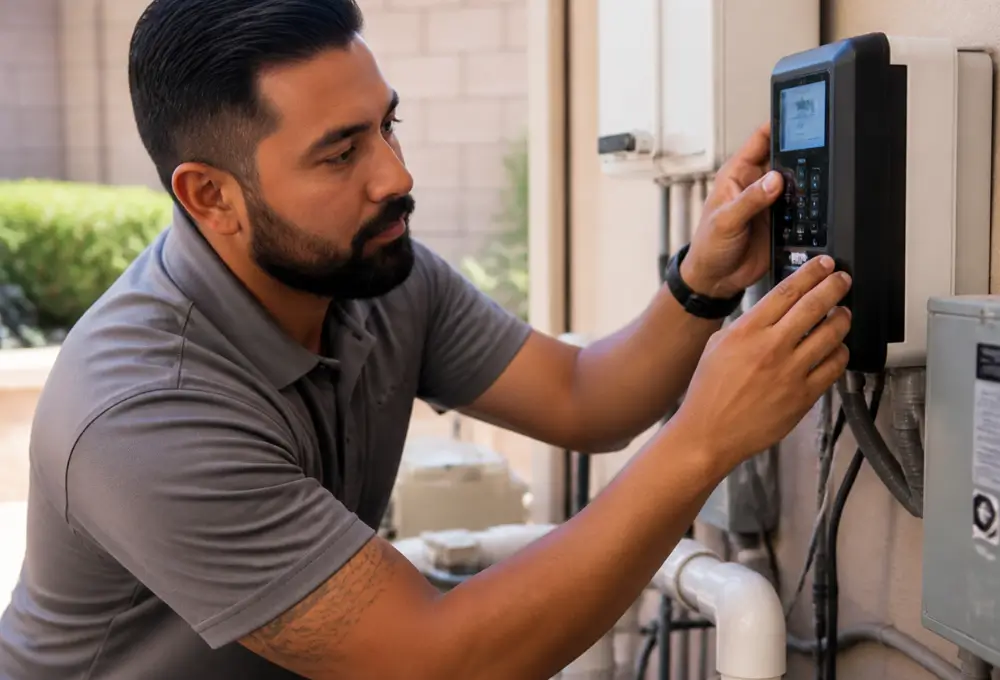
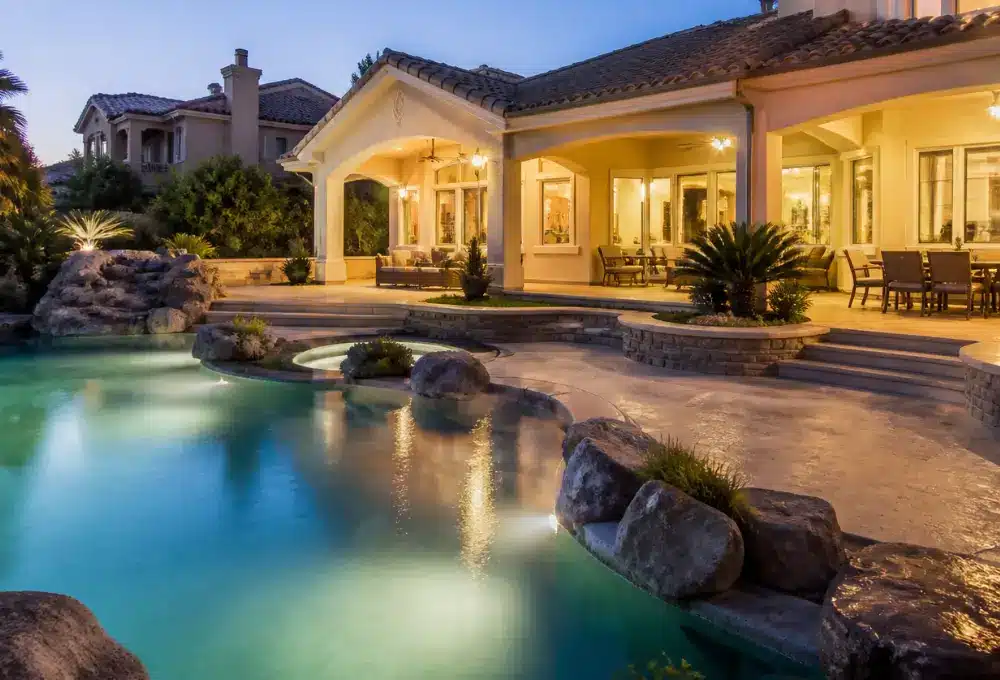
Descriptions of automation tend to be abstract, so here is the concrete version on a typical valley property.
Overnight the pump runs at a low speed, turning the water over quietly and drawing a fraction of the power a single-speed pump would. Early morning it steps up briefly for the cleaner cycle, then drops back. Through the day it holds a low circulation speed, enough to keep the chlorinator producing and the water moving in 105 degree heat.
At five the landscape lights come on with the sun. At six you tap the spa in the app from the car, and by the time you are home the valves have closed to the spa, the heater has been running for twenty minutes and the water is where you want it. At ten the water features and pool lights shut themselves off.
None of that required anyone to walk to the equipment pad, and none of it depends on remembering. That is the whole proposition. Automation does not add capability so much as it removes the friction that stops people using what they already own.
There is a federal rule worth knowing about before your pump fails rather than after.
The Department of Energy’s dedicated-purpose pool pump standard took effect on July 19, 2021, published at 82 FR 5650.
It is widely misdescribed, so here is what it actually says. The rule restricts manufacture and import of non-compliant pumps into the United States. It did not make it illegal to sell stock already in the supply chain, and it did not ban single-speed pumps outright. In practice, most self-priming single-speed pumps at or above 1.0 total horsepower can no longer be manufactured or imported for the US market, which is why replacement options for an older single-speed pump are now largely variable-speed.
What that means for you: if your pump fails, you are most likely getting a variable-speed pump whether or not you planned on it. The real question becomes whether you also get the controls that let it earn its keep, because a variable-speed pump left running at one speed on an old timeclock gives back most of its advantage.
A pool here does not want the same schedule in January that it wants in July, and almost every manually scheduled pool we see is running one compromise setting year round.
Summer in this valley is demanding. Water temperatures climb, sanitizer demand rises with them, evaporation runs hard, and dust and wind load the skimmers. Pools need more circulation in July than in December, and usually more than their timeclock is giving them.
Winter is the opposite. A pool that is not being swum in, at cooler water temperatures, needs far less run time than it is probably getting. That is energy spent for nothing.
Jandy’s AquaLink RS includes a seasonal adjust function that shifts run times through the year automatically, and a properly configured system can hold different schedules for different parts of the system: a long low-speed circulation window, a short high-speed cleaning window, a separate schedule for water features, and another for lighting.
This is the part of automation that pays for itself quietly, and the part that is almost impossible to replicate by hand, because it requires someone to go out and change a timeclock four times a year for as long as they own the pool. Nobody does.
Automation and pump speed are the same conversation, because the single largest energy consumer at a residential pool is the pump.
The physics is the pump affinity law. The Department of Energy’s own measure guide states it directly: halve the pump speed and you halve the flow, but power drops to roughly one eighth of the original draw. DOE’s worked example runs 3,450 rpm at 66 gpm and 2,000 watts, 2,400 rpm at 44 gpm and 593 watts, and 1,200 rpm at 22 gpm and 74 watts. Same pump, same plumbing, three different worlds.
DOE puts pool pump consumption at 3,000 to over 5,000 kWh per year, and says a variable speed pump can reduce pool pump energy use by 50 to 75 percent. That is the largest single efficiency gain available at a residential pool, and it only materialises if the pump actually runs slow, for long stretches, on a schedule. Which is what automation is for.
There is a water quality argument too, and in this valley it matters. A pump running slowly for many hours turns the water over more gently and more completely than a pump running hard for a few. Long low-speed circulation keeps the sanitizer distributed, keeps the surface skimming, and keeps a salt cell producing, which is a meaningful advantage in a climate where water sits at 90 degrees for weeks.
Edgewater installs the Jandy ePump. The 3.8 HP model carries two programmable auxiliary relays for equipment such as booster pumps and salt chlorinators, delivers 24 percent more hydraulic performance than the 2.7 HP ePump, and works with every Jandy automation system and the iAquaLink app.
Where a full automation system is not in scope, Jandy’s SpeedSet Plus controller runs the pump on its own: a dial interface, up to 10 schedules plus 8 additional timed runs, a dedicated high-speed cleaning runtime, and a timed stop that restarts itself. It is a sensible middle step for a household that wants the pump savings now and the rest later.
Automation does not test your water, but it controls most of what keeps chemistry stable.
The Jandy TruClear salt chlorinator can be controlled from the iAquaLink app when combined with AquaLink automation, which means output can be adjusted from the house rather than at the pad. In a valley where summer demand and winter demand are wildly different, that is a setting you will actually change.
The Jandy X-Series AOP systems, sized at 25,000 gallons for the X200, 40,000 for the X350 and 50,000 for the X500, combine ozone and UV-C to generate hydroxyl radicals. Worth stating clearly because the category is often oversold: AOP is a supplemental sanitizer used alongside a primary sanitizer, not a replacement for one. It reduces the chlorine a pool requires rather than eliminating it.
The other chemistry benefit is indirect but real. Consistent circulation is the foundation of stable water, and a scheduled system circulates consistently in a way a manually managed one does not. Our pool maintenance team sees the difference on service visits.
Once the controller is in, the rest of the backyard can join it, and this is usually the part homeowners enjoy most.
Jandy’s Infinite WaterColors LED lights offer 10 preset colours and five light shows, a palette generator for custom shades, and zoning so up to four colours run at once. They run through AquaLink RS and the iAquaLink app, and Jandy publishes a native Alexa skill for voice control. They also exist as nicheless lights and as LED laminar jets, which is worth knowing at design stage.
Water features, spillovers and laminar jets sit on the same system, which is what turns a waterfall from a thing you switch on into a thing that comes on at sunset and goes off at ten. In practice, features that run automatically get used. Features that need someone to go flip a switch at the pad quietly stop running after the first summer.
We install and service outdoor lighting and water features and spill pots across the valley, and both integrate into the same control system.
This is the bulk of what we do, and it is more approachable than most homeowners assume.
Jandy publishes upgrade and conversion kits that bring existing controls onto AquaLink RS, covering older AquaLink, Ji Series, Polaris EOS and SOL, Compool, and Pentair control systems. The All-in-One kits ship as a system board, sensors, relays and the iQ30-A web-connect device, with or without a salt chlorinator, which is a fair picture of what a typical retrofit involves.
There is also a lighter path worth knowing about. The AquaLink TCX conversion kit replaces an old mechanical timeclock inside the existing enclosure without rewiring main power, configures for 115V or 230V on site, and pairs by Bluetooth before joining your WiFi. One detail from the documentation that catches people out: its wireless light switch requires a neutral wire at the existing light switch location, which not every older valley house has.
What typically has to be addressed on a retrofit:
We do not promise that every twenty-year-old heater will talk to a new control system. Sometimes the heater is the limiting piece, and you should know that before the work starts rather than halfway through. If it is at the end of life anyway, doing pool heater installation at the same time is the efficient path.
The app is the headline, but it is not the only interface, and for some households it should not be the primary one.
AquaLink RS supports wall-mounted panels, a wireless handheld remote and a spa-side remote alongside the app. That matters in a few common situations: guests who do not have the app, a household member who would rather press a button, and the obvious case of wanting to change the spa temperature while sitting in the spa rather than fetching a phone.
It also matters for reliability. The control system runs its schedules locally on its own hardware. If your internet connection drops, the pool keeps doing what it was told to do, and the physical interfaces keep working. Only remote app access depends on the connection.
We specify the interface mix during design rather than defaulting to app-only, because the right answer depends on who in the house will actually be operating the pool.
On a new pool, automation is both easier to install and better to live with, because conduit, actuators, relays and sensor runs go in while the trenches are open rather than being chased in later.
It also changes what is practical to design. Automated valves make a pool and spa combination work properly. Scheduled features make a waterfall or a set of laminars something the backyard does on its own. Zoned colour lighting is worth specifying at the start, when the niches are being placed.
We work automation into the plan rather than treating it as an add-on, and you will see the control layout alongside the pool drawing. If you are at the design stage, our custom design drawing services page covers how that process works.
On an existing pool there is one timing point worth knowing. If a pool resurfacing job is anywhere in your plans, doing the automation while the pool is already drained and the equipment pad is open is considerably less work than doing it separately.
For existing pools, a retrofit starts with a look at your equipment pad, which tells us most of what we need to know in about twenty minutes.
Automation is electrical work, and pool electrical work is its own discipline with its own code.
The City of Las Vegas requires a permit to install or alter any permanent wiring or electrical device, to run additional wiring for a new outlet or fixture, and to change out, upgrade or relocate a main electrical panel. The same guide states that in Nevada only licensed plumbers and electricians may do plumbing or electrical work, including homeowners on their own homes. Clark County issues electrical and low-voltage sub-permits through the Department of Building and Fire Prevention; confirm your specific scope with them at 702-455-3000.
Beyond permits, NEC Article 680 governs pools: ground-fault protection on outlets supplying pool motors, and equipotential bonding of the metal components around a pool. One provision matters specifically on retrofits: when a pool pump motor is replaced, reconditioned or repaired, the outlet serving it has to be brought into compliance. Swapping a pump is not always just swapping a pump, and that is a common surprise on older equipment pads.
Code editions differ by jurisdiction and change over time, so the adopted edition where your address sits is what governs. Our licensed electricians work to whatever the authority having jurisdiction has adopted, and the permit is part of the job rather than something left to you.
You can almost always add it. Jandy publishes conversion kits that bring older AquaLink, Ji Series, Polaris EOS and SOL, Compool and Pentair systems onto current controls, and the TCX kit can replace a mechanical timeclock in the existing enclosure without rewiring main power. The usual limiting factor is the heater or the electrical capacity at the pad, not the pool itself.
With iAquaLink: filter pump, booster pump, pool and spa and solar valves, pool and spa temperature, waterfalls, spillovers, laminar jets, light dimmers, colour and white lights, landscape lights, the pool cleaner, and anything else connected to the system. The app is free on iOS and Android and works from anywhere, and it can hold more than one property.
The automation itself does not. The variable-speed pump it controls does. The Department of Energy puts the reduction at 50 to 75 percent of pool pump energy use, on a load it estimates at 3,000 to over 5,000 kWh per year, because halving pump speed cuts power draw to roughly one eighth. Automation is what makes the pump actually run at the low speeds where that saves lives, and what keeps the schedule matched to the season.
Not necessarily. If yours is an older single-speed unit, a federal standard that took effect July 19, 2021 restricts manufacture and import of non-compliant pumps, so replacement options are now largely variable-speed when it does fail. If your pump is still healthy, automation can be installed around it and the pump upgraded later, though you will not see the energy benefit until you do.
It depends on whether the heater has a compatible external control connection. Current units such as the Jandy JXi document automation compatibility. Older heaters vary considerably, and we verify yours during the site visit rather than assuming. If the heater is near the end of life, replacing it alongside the automation is usually the better sequence.
The City of Las Vegas requires a permit to install or alter permanent wiring or electrical devices, and Nevada law restricts electrical work to licensed electricians, homeowners included. Clark County issues electrical and low-voltage sub-permits. Confirm your specific scope with the jurisdiction your address falls in, which is not always the city on your mail.
Yes. The Jandy TruClear salt chlorinator is controllable from the iAquaLink app when combined with AquaLink automation, so output can be adjusted seasonally without going out to the pad.
The control system runs its schedules locally and keeps operating normally. Wall-mounted panels, handheld remotes and spa-side controls also keep working. Only remote access through the app requires the connection.
It depends entirely on scope. Replacing a timeclock with a TCX unit is a different job from a full retrofit with new relays, valve actuators and a variable-speed pump. We give you a realistic sequence after seeing the equipment pad, because the pad is what determines it.
Yes, and for a lot of households that is the sensible order. A variable-speed pump on a SpeedSet Plus controller captures the largest single energy saving on its own, and the control system can be extended to the heater, valves, lights and features afterward.
Edgewater installs and retrofits pool automation across Las Vegas, Henderson, Mesquite, North Las Vegas, Summerlin, Spring Valley, Enterprise, Paradise, Green Valley, Anthem, Boulder City and Centennial Hills.
See also Pool Builder Las Vegas, Pool Builder Henderson, equipment installation and replacement, or request an estimate.





Bill Edgington, Founder of Edgewater Custom Pools, Inc., designed and built the first Edgewater Pool in 1969. Since then, we have constructed over 6,000 pools and spas, mostly on a referral basis.
